
Chronic Back Pain Program After Failed Physical Therapy: What Actually Works
Sep 01, 2026Evaluation · Physical Therapy
By Riaz Fredericks ·
Physical therapy didn't fail you — the math did. One hour a week, against 167 hours of everyday habits quietly working against your back, was never going to be enough.
The ESCAPE System exists in those other 167 hours: the way you sit, breathe, hydrate, and move without noticing — all of it either feeding your pain or healing it. It doesn't replace your therapist. It finishes what one session a week never could.
Physical therapy is built to get you past the worst of an injury — it's the foundation, never the whole house. I learned that the hard way.

Freestyle, lap after lap — the foundation of a three-month program that never touched the real cause.
My three-month program back to fitness was two swimming sessions a week in an Olympic-size pool, freestyle, with someone swimming right behind me the entire time, making sure I went straight back in without rest the moment I touched the wall. The first few sessions, I genuinely thought I might drown before I reached the other end. By month three, I was swimming twenty laps without stopping.
Add two gym sessions a week rebuilding my back-supporting muscles through hundreds of sit-ups and crunches, and a brutal Saturday 5K run through soft beach sand, and I came out the fittest and strongest I had ever been — strong enough to earn my spot back on my men's rugby team.
I was fit. I was strong. But I was never actually fixed — I was maintained. Every week, I was reminded that the underlying injury could resurface the moment I stopped the swims, stopped the exercises, stopped doing exactly what I'd been taught for those three months. One missed week, one bad movement, and I'd be right back where I started, because nobody had touched the one relationship that actually mattered.
That's not recovery. That's management dressed up as a fix.
Why does physical therapy fail some people with chronic back pain?
It's not that physical therapy failed — it's that its map of the body is incomplete. Most of what physical therapy knows about connective tissue was learned from dissecting cadavers and testing assumptions built on dead tissue, which is why it still treats fascia like inert plastic wrap with no real function.
Modern research tells a different story: exercise therapy works for chronic low back pain, but the outcome depends heavily on sequencing and dosage, not just showing up to sessions. Most programs never touch the fascial system at all, and treat strength and flexibility as the whole equation while ignoring mobility and stability — which leaves the deep core (the transversus abdominis) switched off, the psoas compensating, and the pain returning right on schedule.
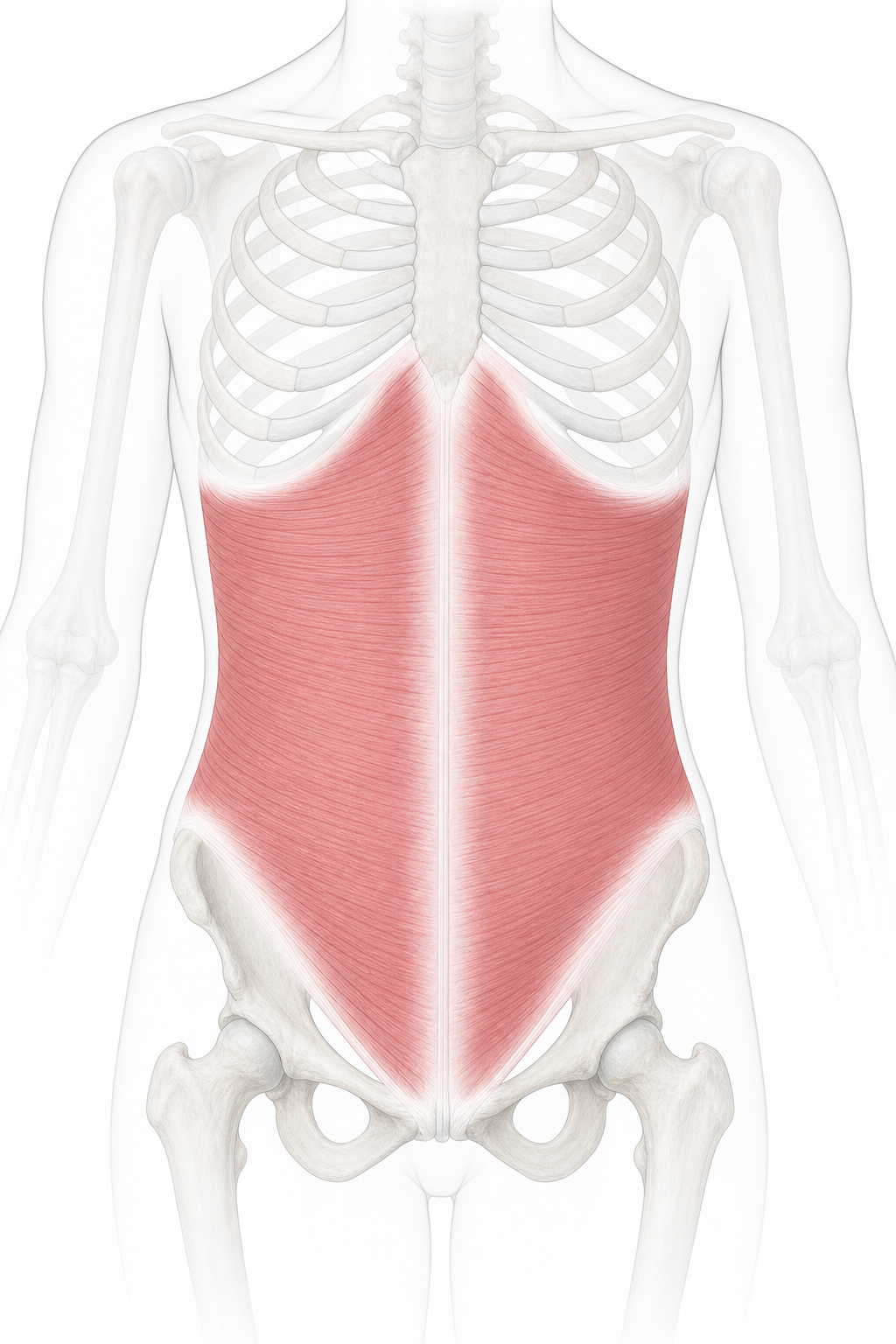
Transversus abdominis (TVA), shown as a closed corset wrapping the torso. It attaches from the inner surface of the lower ribs (costal cartilages 7–12) and thoracolumbar fascia to the iliac crest, linea alba, pubic crest, and pecten pubis.
Related: Why does back pain keep coming back after treatment? →
What makes a program different from standard physical therapy?
A different program starts in the right place, because starting in the right place is the only way you get to where you actually need to go. It took me twenty years and a long list of high-performance therapists, trainers, and doctors to learn that lesson — not because any of them lacked skill, but because none of them were looking far enough back to see what triggered the pain years before it ever showed up.
The ESCAPE System moves through six fixed phases — Educate, Switch, Correct, Activate, Progress, Embody — precisely so no one trains a muscle before the real starting point is corrected.
Related: Structured step-by-step systems vs. random exercises →
What should I look for in a back pain program if therapy hasn't worked?
Look for the "why," not just the "what." A program worth trying explains the mechanism behind your pain before it ever hands you a movement.
- A clear explanation of the root cause, not a generic "strengthen your core" instruction.
- A fixed sequence, not a random list of exercises.
- Built-in accountability, since adherence is one of the strongest predictors of outcome in chronic low back pain recovery.
Your health is the product of your daily habits, for better or worse — and until now, no one has handed you a clear, simple plan for turning those habits in your favor. Winning only happens through consistent, repeatable action, and you're the only person who can take it. The 167 hours were always the real battlefield. This is where that time finally starts working for you instead of against you.
Related: What to look for before buying an online back pain program →
Quick answers
Does physical therapy fix chronic back pain permanently?
Rarely alone — it corrects acute injury but doesn't sustain long-term stability without a follow-up sequence.
What's missing from most post-therapy fitness programs?
Deep core (TVA) reactivation and fascial health, both routinely overlooked.
How is ESCAPE different?
A fixed six-phase sequence that corrects the root cause instead of just building strength on top of it.
Find your own 167 hours.
If you're ready to see where your daily habits are working against you, the free ESCAPE Switch Guide walks you through the first correction — waking up the one muscle every missed program overlooked.

Riaz Fredericks
Creator of the Bula Ball Method and the ESCAPE System, developed from 20+ years of navigating chronic back pain through conventional therapy, high-performance conditioning, and finally correcting what none of it addressed.
Related reading
Why does back pain keep coming back after treatment?
Structured step-by-step systems vs. random exercises
What to look for before buying an online back pain program